Home » Archives for Tamara

Author: Tamara

Tamara (1990) comes from Slovenia, where she finished her bachelor in International relations and is currently doing her master in Management. To balance the more theoretical part she fills her free time with drawing, creating with wood and travelling.
Time to say Goodbye

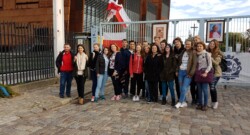
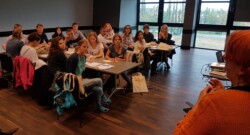
History Campers’ backpacking or rather suitcase-dragging tour from Budapest, through Prague and up (literally) to Gdansk came to an end. Read what they did on their last day, how they re-energized and how they finished the History Camp. So there it came, the very last day of the »Backpacking Višegrad« History Camp. It was Friday that was promising a lot of work with finishing the last tasks and turning them into the future History Campus posts, but also a lot of fun, pleasant moments spent together with the fellow history campers and sadly also showing prospects of goodbye tears. However, let us start with the earliest part of Friday. Morning started with the last breakfast in the full history campers’ assembly. The overheard conversations were filled with reflections upon the Clinton-Trump debate, questions about the departure times, plans for the rest of the day and exchanges of impressions about the past days. After breakfast our history campers were once more ready to seize the day. On their way to the ECS they first said goodbye to our Körber-Stiftung visitors, Katja Fausser and Sven Tetzlaff. Short walk to the ECS was later concluded with a group photo in front of the famous gate of the Gdansk shipyard, followed by an essential energizer for a super-productive start of the day. To get the blood and ideas flowing, our participants tried to learn counting in Welsh, Ukrainian and Slovenian, accompanied with carefully selected dance/seizure-like moves. The day continued with writing articles based on the interviews with the journalists, an editor and a political analyst from the day before. The working room and hallway were full of very concentrated looks focused on notebooks, computer and tablet screens, typing sounds, fruitful debates, useful and instructive discussions with our journalist-consultant Clemens as well as some frustration over the workflow, as expressed with Vida’s worried and wondering question to Ema »Why are you pressing pause, when I did not hear anything?« (leaving Ema without an answer, just with a similarly wondering look). Luckily, the frustration was just a quickly-passing-by one. The afternoon was dedicated to finalising the tasks from the first two cities on our history campers’ map: Budapest and Prague. When the evening came and all the hard work was finally done, young journalists more than deserved the presentation of the results of their work and effort. Thus, with presentation of videos, photo-sliders, GIFs and texts, the working and learning part of the History Camp was over. What followed was a dynamic feedback on the »Backpacking Višegrad« History Camp, which is going to be analysed and taken into consideration by the organising team. Shortly before dinner, the participants got the instructions for the departure day to come and were presented with the timetable of transfers to the Gdansk airport, which caused the usually happy looks turning into very sad, and even some tearful ones. The farewell dinner, of course now already traditionally with the green dragon, finished with the last video, during which participants reflected upon the just ending History Campus and shared their impressions as well as its most memorable moments. Thus the unforgettable »Backpacking Višegrad« History Camp became a finished chapter and slowly started its transformation into very dear and exceptional memories.

@work in Gdansk, day 7: Switching the roles – interviewing the usual interviewers

On their second day in Gdansk, our participants realized that the “Backpacking Višegrad” History Camp is slowly coming to an end. Saddened by this fact, but highly motivated, they began their day that promised interviews, media archives, a library… and ended with a very unique public performance.

Learning About Solidarity and Bloody Pacifications of Protests

Wednesday is the day for starting a new, this time Polish, adventure in the city of Gdansk. The first day in Gdansk included four interesting and inspiring interviews, a visit to the Solidarity centre’s library and their archive, where our participants looked at, touched and explored the leaflets, posters and other interesting documents, produced by the Solidarnosc movement. As the train was rushing in the direction of Gdansk, our persistent and motivated history campers used that time to finish the tasks from Prague and make sure you will be able to see and experience Prague’s street beat. Just before noon they entered the lovely city of Gdansk – the final destination of the »backpacking Višegrad« History Camp. Since the afternoon agenda included a tour through the museum and preparation for the interviews, they first needed to fuel up with a delicious lunch at the hostel. Fully energized, our participants started discovering the streets of Gdansk, while making their way to the European Solidarity Centre (Europejskie centrum solidarnosci – ECS). There they were warmly welcomed by Anna Zielinska, the head of the education department, and taken on a guided tour through the museum. Thus, they followed the chronological developments of the events that established the Solidarnosc movement and led to introduction of the martial law. Impressed by the exhibits and the art of presenting the events connected with the Solidarnosc movement, the history campers returned to the hostel. No internet, no problem Since the day was far from being over, Tina and Clemens (our project manager and the consulting journalist) presented them with a task for the next day. Namely, Thursday will revolve mostly around the interviews of Russian and Polish journalists, an editor and a political analyst – a promising fact for acquiring interesting information about media freedom, political propaganda and journalistic ethics.   However, before preparing the questions for the interviewees, our history enthusiasts first needed to get acquainted with the current socio-political situation in Poland. In order to do that, we have sent them through the time-machine: instead of internet they had to use a pen, paper, their journalistic approach and curiousity and hit the streets of Gdansk, where they interviewed people on the current situation in Poland. As usually, they came back with interesting information and experiences and started working on the questions for tomorrow’s interviewees. Ending the day with the green dragon The first day in Gdansk ended with a green dragon, who took care of the dinner for our participants and the organizing team. The latter was this evening enriched by the company of Katja Fausser and Sven Tetzlaff from Körber-Stiftung. Joined by the newcomers we ended our first night in Gdansk as all the other nights before – be it either in Budapest, Prague or somewhere in between – with a live stream.

On the Trace of Social Movements and People’s Uprisings

After two days in Prague our history “campers” felt the need to move again. This time they followed the traces of social movements and people’s uprisings to the north and ended in the city of Gdansk. How they spent and finished their second day in Prague and how they entertained themselves on their trip is presented in today’s blog entry – check it out! Our Tuesday, still in Prague, started with getting some more journalistic education on writing articles, personal opinions and reviews. Thus, our Višegrad backpackers got valuable tips for their future journalistic adventures, which were put to practice already in the afternoon of the same day. Tips on traditional journalistic formats were later broadened with presentation of newer, more modern and inovative media formats, introduced and published on the History Campus platform. Nineteen young history »campers« learned about the strange sounding formats and categories such as History to go, Where were you when… ?, What If GIF, European street beat and Memory suitcases (to get an idea what these names actually represent, take a look at the History Campus platform – seriously, it is worth checking ;)). Full of new and refreshed knowledge, the young campers seized the day with going out to the sunny and rather touristically crowded streets of charming Prague, gathering material to contribute to the uncommon journalistic categories and of course to broaden their knowledge about the current »street beat« of Prague. From conversations and recordings to GIF’s and movies Hard work on the streets and squares paid off in form of an abundance of opinions, photos, and facial reactions gathered, which enabled them to continue their work of transforming all that into videos, GIFs and articles (follow our blog and the History Campus also after the end of the Višegrad History Camp to see them published). As usually during projects involving smart, young, ready-to-learn and interested people, group work turned out to be very productive, educational, and also a lot of fun. In the meantime issues with the internet connection took care for some more dynamic and unusual work-spots (stairs proved to be just as good as a regular office-desk). Don’t cry for me… Prague We said goodbye to Prague (and promised to return – which you already know if you tuned in into our Facebook live-stream – every day at 9 PM) in style with dinning in an old Prague restaurant, where we enjoyed beautiful live piano music along with the delicious food. However, in order not to clinge just to the past, we used the last chance of a goof wi-fi connection to equip ourselves with a more current form of entertainment – with the first round of the USA’s presidential debate between Hillary Clinton and Donald Trump. Ready for new adventures in a new country, we hopped on a tram (well, honestly, our luggage made us a bit less »hoppy«), which took us to Praha hlavní nádraží, where we boarded a night train to Poland. While we were sleeping, and our brains were processing all the information we got in Budapest and Prague, and also chewing on what we just heard and saw in the American presidential debate, we crossed the border and entered Poland. However, more on our Polish adventures in the tomorrow’s blog post – stay tuned and scroll down to read some of the impressions from our participants 😉 Anastasija, Latvia »Yesterday was a good experience for me and my group,. We did exciting work, going to the center of Prague and talking with people there.«  Irina, Russia »I walked the streets of Prague with Eva, and it was really interesting to listen to the Czech language. It was of course hard to understand people, but it still made a good walk, because we got to know people’s feelings about the communist part of the Czech history.« Elena, Spain »I had a great time in the city, hanging out with people, learning about journalism and having an experience I never had before and never expected. It is a unique experience I will never forget.« Fedir, Ukraine »Well, the most memorable thing about the last day in Prague was how people on the streets talked to us. They were not very polite, which is unusual, and it made our journalistic task really hard, harder than imagined.« Elin, Wales »I really enjoyed yesterday. It was very interesting to interview people and getting lost in Prague – that was the best thing, since it was nice to have some free time there J I also really enjoyed our dinner.« Karl-Martin, Estonia »Unlike Elin, I did not get lost, I had a map. So far Prague is my favourite city in the world, so it was very nice to be there and to walk across my favourite bridge. The food was very good too, it was nice to eat traditional Czech food. And of course, watching the presidential debate until the early morning hours was also very interesting.«

@work in Prague, Day 4: New day, new city, new experiences: Socialism realised

New week deserves a new location of our History Camp – from Budapest we moved to Prague to analyze yet another uprising – the Prague Spring of 1968. Have a look at our first day spent in the Czech capital and learn what we did, which institute we visited and which different and inovative means of transport we used in only one day.

  • 1
  • 2